The 8:40 Club: Chelmsford’s Crossing Patrols and the Quiet Art of Getting Everyone Across
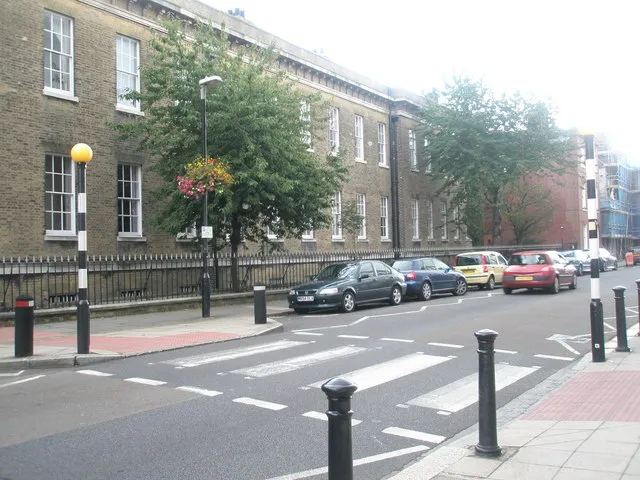
Photo: Basher Eyre, CC BY-SA 2.0, via Wikimedia Commons
There is a particular kind of Chelmsford morning that begins with a scrum of buggies, scooters, book bags and last-minute reminders about PE kits. The pavements fill, the cars queue, and somewhere near the school gate a figure in hi-vis raises a sign and waits for a gap. Rain or shine, the school crossing patrol is part of the furniture of local life — familiar, unfussy and quietly essential.
You may know them as the lollipop lady or lollipop man. In Chelmsford, as across Essex, the official title is school crossing patrol. But the role is bigger than the title suggests. These are the people who learn which child is nervous about starting Reception, which buggy has a squeaky wheel, and which parent is always running thirty seconds late. They are neighbours with a sign, a tabard and a very specific kind of local knowledge.
More than a sign and a smile
A crossing patrol’s job is to help children cross the road safely at agreed times and locations. They are not traffic lights and they cannot magic cars away. They rely on drivers paying attention, on families following their signals, and on everyone remembering that the school run is a shared space rather than a race.
What makes the role special is the continuity. Patrols see the same families five days a week, term after term. They watch children grow from Reception wobbles to Year 6 confidence. They notice when a child has a new bike helmet or when a family has had a tricky morning. A good morning from the person at the kerb can set the tone for the whole day — for the child and for the grown-up holding their hand.
In a town that is always growing, with new estates and new school runs, those fixed points matter. The patrol at the end of your road is a small civic ritual: a person who turns up, knows the rhythm of the neighbourhood and helps everyone get where they need to be.
How the service is staffed and supported
Across Chelmsford, school crossing patrols form part of the wider Essex County Council service. The council recruits paid, part-time, term-time patrols for sites where a crossing has been assessed as needing one. Training, uniform and ongoing support are provided, and sites are reviewed as traffic patterns and school rolls change.
It is not a job for everyone. You need to be comfortable standing out in all weathers, happy to chat with children and parents, and firm enough to wait for the right moment rather than the first gap. But for the right person, it can fit neatly around school hours or retirement. It suits someone who likes being part of a neighbourhood and does not mind being the person everyone recognises.
If you have ever thought about it, the practical first step is to look at Essex County Council’s school crossing patrol vacancies or ask at your school office whether a local site is recruiting. Schools and the council can explain the hours, the training and what the role involves. It is worth saying plainly: these roles do not fill themselves, and a reliable patrol is one of those services nobody notices until it is missing.
The darker-morning checklist for 2026
Now that the clocks have changed, the morning school run is lighter later and the afternoon run is dimmer earlier. That makes the patrol’s job more important and everyone else’s behaviour more visible. A few practical habits can make a real difference.
- Leave five extra minutes. Rushing is the enemy of safe crossing, especially on wet leaves and dark corners.
- Choose bright coats, bags and reflectors where you can. A child in dark clothing on a gloomy November morning is harder to see than you think.
- Park considerately. Do not stop on zig-zags, double yellows or the kerb near the crossing. The few seconds you save are not worth the sightlines you spoil.
- Hold hands with younger children and put phones away at the kerb. A distracted adult is not a useful role model.
- Wait for the patrol to signal. Do not step into the road because a driver has waved you on. The patrol is watching the whole road, not just one car.
- Teach the routine: pavement, kerb, listen, look, cross. It sounds old-fashioned because it works.
- Make eye contact with drivers where possible. Never assume a car has seen you simply because you can see it.
- Say thank you. It costs nothing and it reminds children that the person in hi-vis is a neighbour doing a job.
If you see a near miss or a recurring problem at a crossing, tell the school or the council rather than saving it for social media. Local authorities can review sites, adjust markings or speak to the school community. The patrol on the ground can only do so much if drivers are ignoring the rules behind them.
The quiet glue of the school run
Crossing patrols are not usually the people who get medals or headlines. They are the ones who stand in the drizzle at 8:40 and again at 3:15, holding a sign and remembering that the small person in the shark wellies likes to press the button. They see the town at its most ordinary and most human: tired parents, excited children, grandparents doing pickup, dogs waiting patiently, siblings arguing about whose turn it is to carry the water bottle.
In Chelmsford, that quiet consistency is worth celebrating. The patrols who know every child by name — or at least by coat, buggy and preferred breakfast chat — are part of what makes a neighbourhood feel like a neighbourhood. They keep the school run moving, but they also keep an eye out. They are the friendly face at the kerb, the daily hello, the small proof that someone is looking after the crossing.
So next time you wait at the kerb, give them a wave. And if you have a spare hour and a bit of patience, maybe ask whether your local crossing needs a new patrol. The 8:40 club is always looking for people who know that the job is less about stopping cars and more about starting the day kindly.